
Modern vault infrastructure has quietly won an argument that used to be contested. Capital follows opportunity, and opportunity isn't chain-specific. The best vault providers no longer build for a single chain. They build for wherever the yield is, and they route capital across the ecosystems where strategies actually live.
Look at how a provider like Lagoon Finance thinks about this. Curators ship vaults across delta-neutral, RWA, lending, and yield strategies on Ethereum, Arbitrum, Base, Optimism, and more. The thesis is coherent and it's correct. If a strategy earns better returns on one chain than another, the infrastructure should be able to follow it there. Chain-agnostic by design.
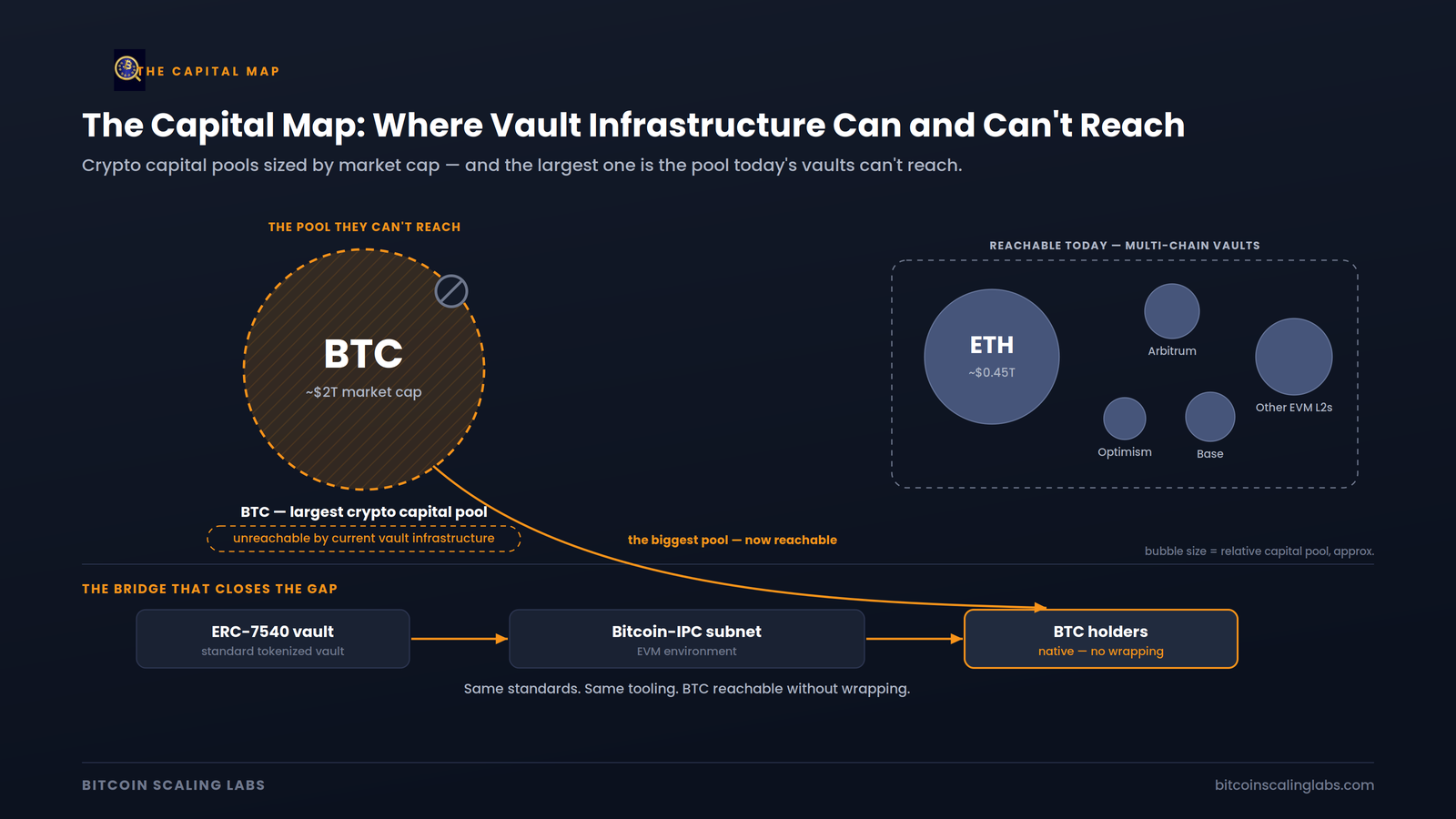
There's one line on that supported-chain list that's conspicuous by its absence. The largest pool of crypto-native capital in existence isn't on it.
The pool nobody's vault can reach
Bitcoin is the biggest asset in crypto by a wide margin. It's the deepest, most liquid, most widely held store of value the industry has produced. By any honest measure, it's the single largest reservoir of capital that could, in principle, be put to work in a vault.
And it's the one pool multi-chain vault infrastructure structurally cannot reach.
The reason isn't demand. BTC holders ask for yield constantly, and a whole sub-industry has grown up trying to give it to them. The reason is architectural. Modern vaults are built on Ethereum's token standards. An async vault following the ERC-7540 pattern, issuing ERC-20 shares to depositors, needs an EVM environment to run in. Ethereum has one. Arbitrum, Base, and Optimism have one. Bitcoin's base layer does not.
So the supported-chain list is entirely EVM, not because vault providers don't want BTC, but because there's been nowhere native to put a vault that a Bitcoin holder could use without leaving Bitcoin.
The two workarounds, and where they fall short
The industry's answer so far has been to route around the problem rather than solve it.
Wrap the BTC. Convert Bitcoin into a wrapped token on Ethereum, then treat that token like any other EVM asset. This works mechanically. It also means the "Bitcoin" in the vault isn't Bitcoin anymore. It's an IOU on another chain, carrying bridge risk, custodian risk, and a security model that has nothing to do with the network the holder actually trusts. For the large, conservative holders who make up most of the BTC pool, that's a non-starter.
Send it to a staking protocol with opaque economics. The other path hands BTC to systems with insider-heavy token structures and trust assumptions that a serious holder can't fully audit. Different risk, same result: the holder gives up the thing they valued about Bitcoin to chase yield on it.
Both approaches ask the Bitcoin holder to stop being a Bitcoin holder. That's why the largest capital pool in crypto stays on the sidelines of the vault economy. Not for lack of appetite. For lack of a native place to go.
We've made this same argument before in a different context. Our piece on reaching BTC holders without wrapping for tokenized assets makes the identical case for RWA distribution: the way to bring Bitcoin capital to onchain opportunity isn't to drag Bitcoin onto Ethereum, it's to bring the opportunity to where Bitcoin already is.
Meeting the demand where it actually is
A Bitcoin-IPC subnet closes the gap without asking anyone to change what they hold.
Bitcoin-IPC is a network of permissionless Layer 2 subnets secured by Bitcoin L1. Each subnet is a Proof-of-Stake chain where validators stake BTC directly, with subnet state periodically checkpointed back to Bitcoin so the base layer remains the source of truth. The BTC stays native. It isn't converted into a token on a foreign chain, and it isn't bridged away from Bitcoin's security.
The part that matters for vault infrastructure: Bitcoin-IPC subnets are fully EVM-compatible.
That single fact removes the wall. The same standards vault providers already build on work here unchanged. An async vault following the ERC-7540 pattern runs on a Bitcoin-IPC subnet exactly as it would on an EVM L2. Depositors hold standard ERC-20 vault shares. The tooling curators, valuation managers, and vault admins already use works out of the box, because the environment is EVM underneath, with Bitcoin as the settlement and security layer beneath that.
For a multi-chain vault provider, this doesn't mean learning a new architecture. It means the supported-chain list can finally include the one pool it's been unable to reach, using the exact infrastructure the provider already runs. Same ERC standards. Same tooling. BTC holders reachable natively, without wrapping, without a bridge, without asking them to leave Bitcoin.
What this unlocks
Put the pieces together and a new category becomes possible: a vault where BTC holders earn yield on native Bitcoin, denominated in a Bitcoin-aligned reward token, with their stake never leaving Bitcoin's security model.
- Curators manage validator selection and staking parameters at the strategy level, the same way they manage any other vault strategy.
- Valuation managers calculate NAV against the subnet's rewards, using the same processes they run today.
- Vault admins configure compliance and access with the standard controls they already apply.
- Depositors hold ERC-20 vault shares representing their position, transferable and composable across the subnet network.
- The reward token, IPC-BTC, follows Bitcoin's own economic model: a 21M supply cap, halving emissions, fair launch, and zero insider allocation.
The demand for Bitcoin yield was never the missing piece. The missing piece was somewhere to meet that demand on terms Bitcoin holders would actually accept. EVM-compatible, Bitcoin-secured, native. A Bitcoin-IPC subnet is that place.
The largest capital pool in crypto has been waiting for infrastructure that comes to it, instead of asking it to leave. That infrastructure now exists.
Learn more
Read the Bitcoin-IPC whitepaper, explore the documentation, and review the code on GitHub.
Watch our demos, including ERC-20 token issuance on Bitcoin-IPC.