Most of the Bitcoin scaling conversation is an argument about supply. How many transactions per second? How low is the fee? How many Layer 2 chains exist? These are real questions, but they answer the wrong half of the problem. Supply only matters if there is demand to meet it, and the more interesting question is this: who actually needs to move BTC at scale, and why now?
Two answers are already visible, laid out below as two demand curves. Neither is speculative. And in a recent Milk Road interview, both were articulated not by a Bitcoin infrastructure team with something to sell, but by Ben Werkman, Chief Investment Officer of Strive, a publicly traded Bitcoin treasury company. When the people holding BTC on their balance sheet describe the same demand as research papers, these things are worth paying attention to.
Demand curve one: neutral settlement in a fragmenting world

Werkman's argument was simple. Every time a major geopolitical rupture occurs, Bitcoin moves to the center of the conversation. When Russia was cut off from SWIFT, the question of how to move value without a permissioned intermediary became urgent overnight. When sanctions constrained Iran, Bitcoin became a practical rail. When BRICS nations discussed an alternative settlement currency, the same property kept surfacing: the need for an asset that no single authority can freeze, reroute, or switch off.
This is the property that makes Bitcoin structurally different from the rails that move money today. Correspondent banking and SWIFT messaging depend on intermediaries, and an intermediary is a point of control. It can refuse a counterparty. It can freeze an account. It can cut an entire country off the network. The rail is only as open as the institutions running it decide it should be.
A bearer instrument has no such gatekeeper. Value moves peer to peer, and there is no party in the middle to pressure, sanction, or remove. Crucially, the same rail serves an individual, a corporation, and a nation without distinction. As currency itself becomes an instrument of conflict, that neutrality stops being a philosophical talking point and becomes an operational requirement.
The problem is that neutral settlement is only useful if it works at scale. A rail that clears twelve transactions per second cannot serve individuals, corporations, and nations at once. And the usual workaround, a trusted bridge between chains, quietly reintroduces the exact chokepoint that neutral settlement is supposed to eliminate. A bridge is a committee, and a committee can be leaned on, cut off, or compromised. Solving the throughput problem by adding a gatekeeper defeats the purpose.
This is the gap Bitcoin-IPC is built to close. It scales Bitcoin into a network of programmable Proof-of-Stake subnets whose stake is denominated in real L1 BTC, and it does so without an external bridge. Every subnet settles to Bitcoin, and cross-subnet transfers route through Bitcoin itself, lifting monetary throughput from roughly 12 transactions per second to over 270, with no change to Bitcoin L1. The neutrality is preserved because there is no new trust set to capture.
Demand curve two: the machine economy
The second demand curve has nothing to do with geopolitics, and it may end up being the larger of the two.
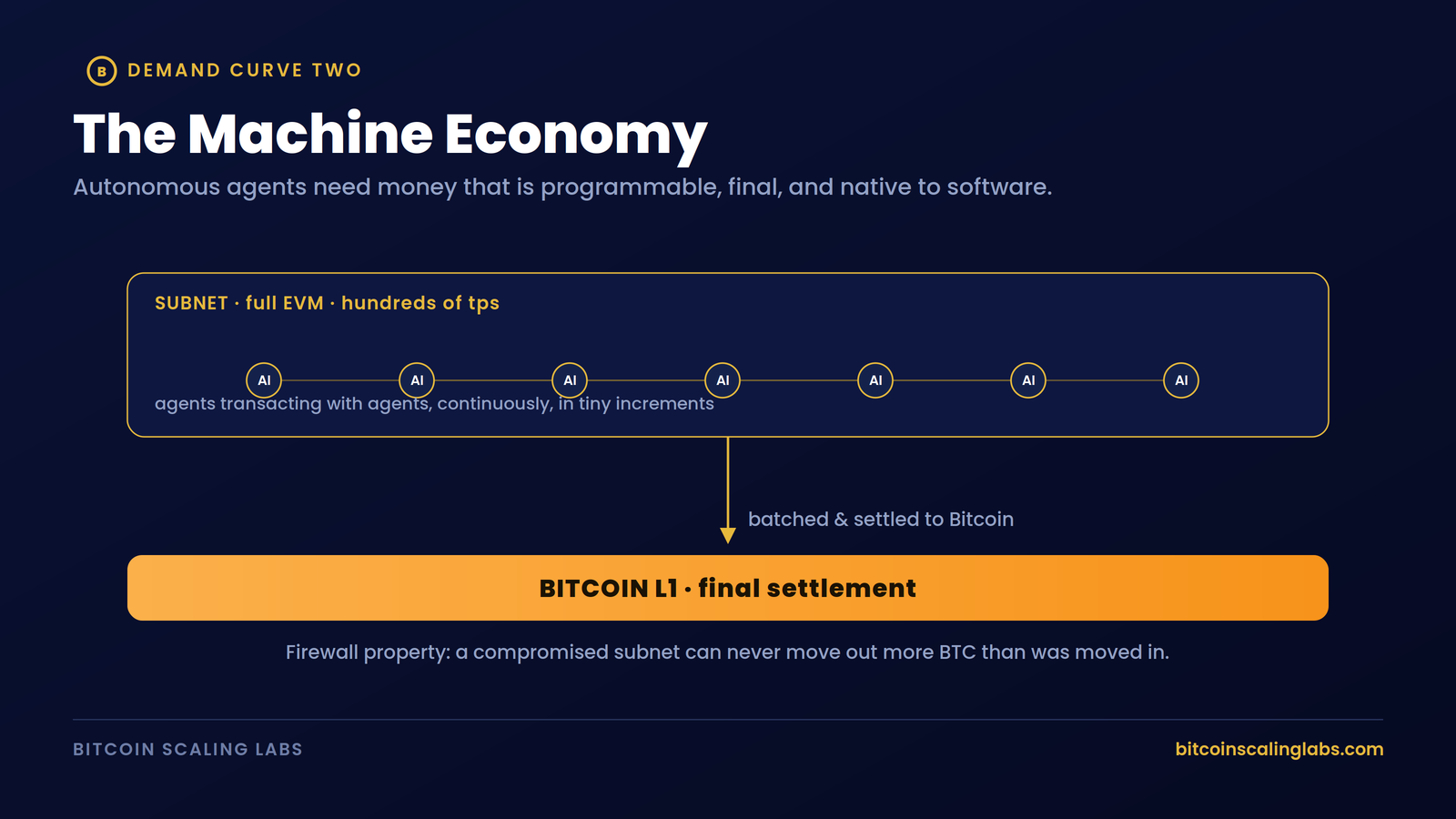
Software agents are beginning to transact on their own behalf. They buy compute, pay for data, settle with other agents, and do it continuously and in tiny increments. Werkman made the point directly: if you are building infrastructure where AI agents transact between each other, you need a digitally native asset to do it. The Bitcoin-IPC paper anticipates exactly this, describing a future target not just of eight billion people but of many more autonomous agents.
Consider what an agent actually needs. It cannot open a bank account. It cannot pass a manual compliance check for every micropayment. It needs money that is programmable, final, and native to software rather than to an institution. Card networks and bank wires were built for human counterparties at human frequency, and they break down completely at the volume and value that agent-to-agent commerce implies.
Bitcoin is the natural settlement asset for this economy, because it is a digitally native bearer instrument with no counterparty. But native Bitcoin alone cannot carry agent traffic. The volume is too high, the individual payments too small, and there is no smart-contract layer for the logic an agent needs.
A network of programmable subnets changes the picture. Agents transact on a subnet with full EVM programmability, at hundreds of transactions per second, with the logic to express whatever the interaction requires. Those transfers are batched and settled to Bitcoin rather than sent to L1 one at a time, which is how the effective throughput reaches the level agent commerce would demand. And the firewall property, which follows directly from Bitcoin's UTXO model, guarantees that a compromised subnet can never move out more BTC than was moved into it. For an economy run by autonomous software, that containment is not a nice-to-have. It is the precondition for trusting the system at all.
In addition, subnets can transfer value to any other subnet without pre-reserving liquidity in a seamless way, with no bridging involved. Agents are unlikely to all flock to a single L2 for trust and security reasons. However, with Bitcoin-IPC this is not a concern, as it is horizontally scalable. Any pair of subnets is automatically bridged through BTC L1 without the use of any external, insecure bridges.
Why the corroboration matters
It is easy for an infrastructure team to describe the use cases its own technology serves. It is more interesting when someone on the demand side, with capital committed and no reason to flatter a particular design, independently names the same two.
Werkman was not talking about subnets or Layer 2 architecture. He was explaining why he is confident holding Bitcoin on a corporate balance sheet. And the reasons he gave map precisely onto the two demand curves that make scaling urgent: a neutral settlement asset for a fragmenting world, and a digitally native asset for a machine economy that is arriving faster than the rails to support it.
The supply side of Bitcoin scaling is a solvable engineering problem, and Bitcoin-IPC is our answer to it. The demand side is already here. The work now is making sure the rails are ready before the traffic is.
Building for either of these demand curves, neutral settlement or machine-native payments? Contact us to explore what a network of Bitcoin subnets makes possible.