
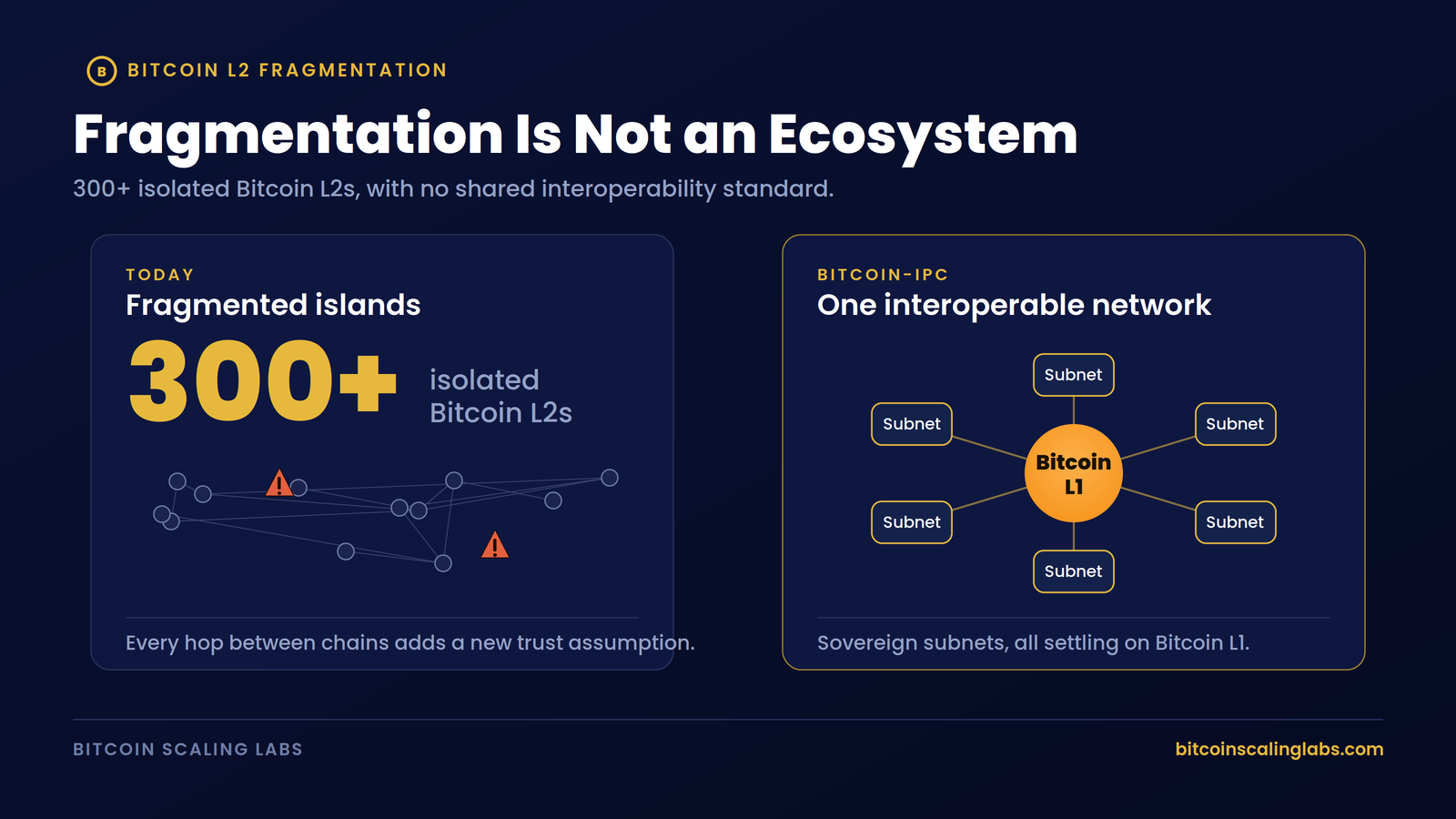
There are now more than 300 Bitcoin Layer 2 chains. The industry treats this number as a milestone, proof that the Bitcoin scaling thesis is alive and accelerating. The number is real. The conclusion is wrong.
A count of 300 isolated chains with incompatible security models is not an ecosystem. It's fragmentation wearing the costume of growth. Will any of these chains individually attract all Bitcoiners? Mixed security guarantees and inherent lack of scalability of any individual chain make this very unlikely. But even with more than one winner, how will these L2 chains interoperate with each other?
The vanity metric problem
Every ecosystem dashboard wants a number that goes up. Total value locked, number of chains, number of protocols. These metrics reward proliferation regardless of whether the things being counted can actually work together.
Bitcoin L2 count is the clearest example. Each new chain adds to the tally. None of them are required to interoperate, share a security model, or let a BTC holder move between them without trusting a third party. The dashboard celebrates a bigger number while the underlying experience for users gets worse, because there are now more isolated islands to bridge between.
What fragmentation actually costs BTC holders
The core promise of holding BTC is that you don't have to trust an intermediary. Bitcoin settles trustlessly, and that's the entire point.
The moment a BTC holder moves value from one L2 to another, that promise usually breaks. Most Bitcoin L2s connect to each other and to Bitcoin through trusted bridges: federations, multisig committees, or custodians that hold the real BTC and issue a representation on the destination chain. Each hop adds a trust assumption the holder never wanted.
This is the structural cost of fragmentation. It's not just inconvenient. It systematically reintroduces the counterparty risk that Bitcoin was designed to eliminate. We've documented how this same flaw produced roughly $2B in bridge exploits across the industry.
More chains, more bridges, more blast radius
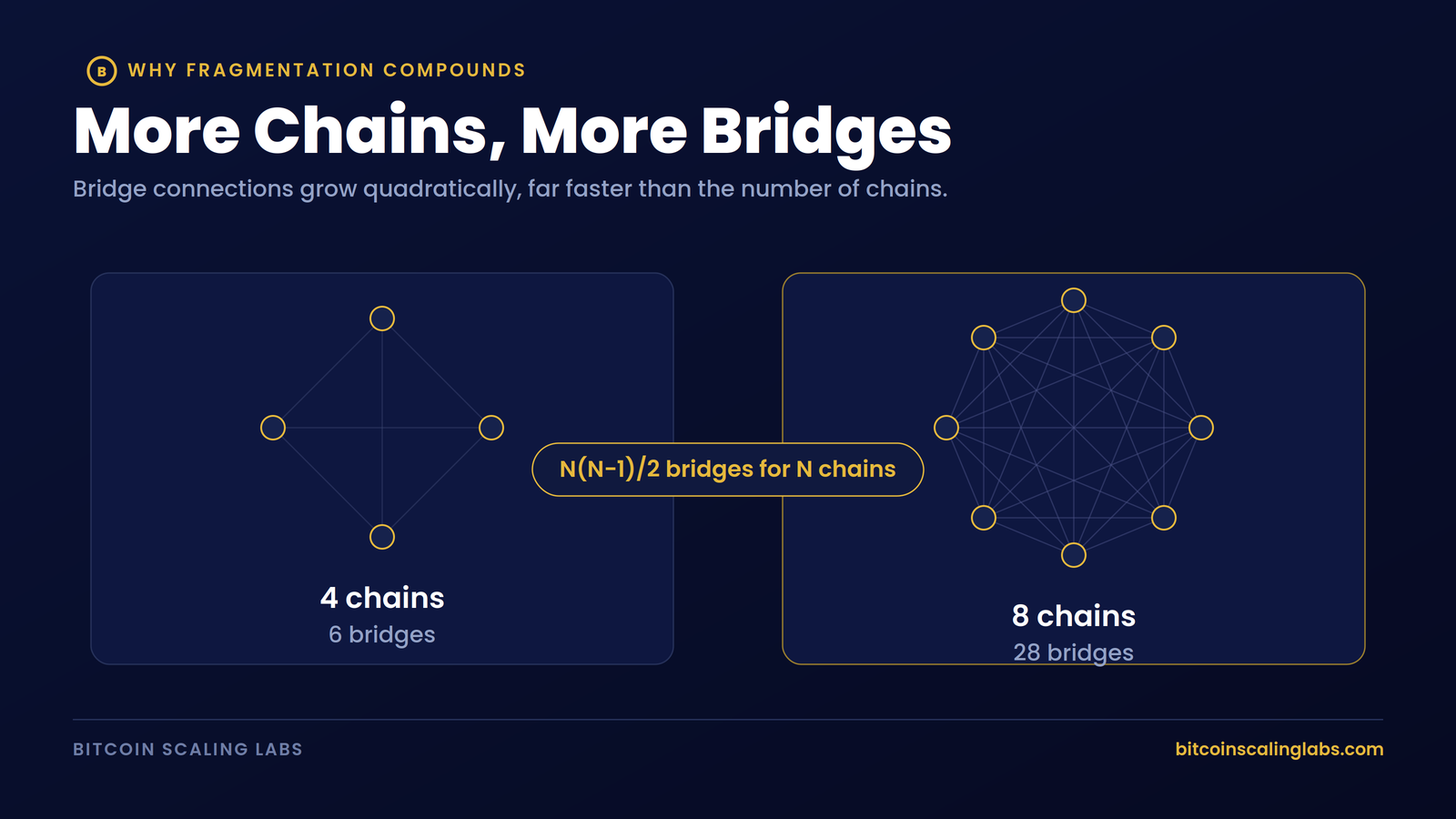
Fragmentation compounds. With 300 chains and no shared interoperability standard, the number of potential bridge connections between them grows quadratically, much faster than the number of chains. Every one of those connections is a separate piece of infrastructure with its own signer set, its own assumptions, and its own attack surface.
The industry's response has been to build better bridges. Bigger multisigs, MPC custody, ZK attestations of bridge behavior. Or spinning up new chains that serve only cross-chain bridging capabilities. These are improvements to a structure that's fundamentally fragile. A better committee is still a committee standing between Bitcoin and your assets.
This is why fragmentation without interoperability is worse than having no L2s at all. A world with zero Bitcoin L2s has BTC sitting safely on L1. A world with 300 trust-incompatible L2s has BTC scattered across chains, reachable only through intermediaries that each represent a point of failure.
What a real interoperability standard requires
If the goal is a coherent Bitcoin L2 ecosystem rather than a leaderboard of isolated chains, the interoperability standard has to satisfy a few non-negotiable requirements.
Settlement to Bitcoin as ground truth. Every chain in the network must checkpoint its state to Bitcoin L1, so that Bitcoin remains the final arbiter of truth rather than any individual chain. Checkpointing provides a secure method for preventing long-range and “I still work here” attacks on Proof-of-Stake and federated sidechains.
No additional trust set for cross-chain movement. Moving value between chains should not require trusting a new committee. The same validators a user already relies on to operate a chain should be the ones securing its connection to Bitcoin.
Contained blast radius. A compromise of one chain must not be able to forge or inflate assets on another. We call this the firewall property, and it's a core design principle in our Bitcoin-IPC, a network of sovereign Bitcoin L2s.
Sovereignty without isolation. Chains should be free to choose their own validator set, gas token, and upgrade cadence, while still being able to move assets to each other natively.
Seamless network-wide addressing and UI. Sending value across L2s should be as simple as sending value within an L2. Traditional banking provides an inspiration here with universal SWIFT/IBAN addressing, which hides from users the heterogeneity of payment systems in the backend.
No foreign L1 for bridging and interoperability. Bitcoin L2s scale the most secure decentralized network in the world, Bitcoin. Why should interoperability solutions use other custom L1 networks, with lower security, for bridging across L2s? Using Bitcoin for interoperability directly is an obvious, simplest and most secure solution.
How Bitcoin-IPC approaches the standard
Bitcoin-IPC is built as a network rather than another isolated chain. Subnets are sovereign, with their own validators and their own gas token, but they all settle to Bitcoin L1 and can move assets between each other without external bridges, using Bitcoin L1 itself.
Cross-subnet transfers route through Bitcoin L1 using a SWIFT/IBAN-inspired addressing protocol, which boosts Bitcoin's L1 monetary transaction throughput from 12 to 273 tps. The multisig holding a subnet's BTC is controlled by that subnet's own validators, not a separate federation, so there's no extra trust set bolted on. Our Bitcoin-IPC firewall property further ensures a compromised subnet cannot forge tokens elsewhere in the network.
The result is horizontal scalability that adds capacity without adding fragmentation. More subnets mean more throughput capacity, which remains connected via Bitcoin L1, not more isolated islands.
Stop counting chains. Start counting trust assumptions.
The healthiest possible metric for the Bitcoin L2 category isn't the number of chains. It's the number of trust assumptions a BTC holder has to accept to use them. By that measure, 300 fragmented L2s is a step backward, and the work ahead is consolidation around interoperability, not further proliferation.
Building or operating a Bitcoin L2 and thinking about interoperability? Contact us to find out more and explore collaborations.