The demand is proven. Over 38,000 BTC (and historically up to 57,000 BTC), worth more than $3 billion, have been staked through Babylon alone. That number answers the question "do Bitcoin holders want yield on their BTC?" with a volume that leaves no room for debate.
The harder question is whether any of the current approaches give them what they actually need: yield that comes from securing Bitcoin infrastructure, with tokenomics that don't redistribute value to insiders, and enough programmability to build institutional products on top.
Three projects have shaped the BTC staking market so far, offering non-custodial yield, allowing BTC holders to keep their BTC custody. Each one proved something important. Each one left something unresolved. This is an honest look at what they got right, where they fall short, and what Bitcoin-IPC is designed to take from each.
Babylon: Demand at Scale, Tokenomics That Don't Match
Babylon proved the market exists. That's not a small thing. Before Babylon, "BTC staking" was a thesis. With Babylon, it is 38,000 BTC locked and a category everyone else has to address.
What they got right. Babylon built a trustless staking protocol where BTC holders stake directly on Bitcoin L1. No wrapping, no bridging, no custody transfer. The BTC stays in the holder's control, locked in a self-custodial vault on Bitcoin itself. That's architecturally clean, and it's the reason Babylon attracted the volume it did. Bitcoin holders who refuse to wrap their BTC or send it to a foreign chain found a staking model that respected that conviction.
Babylon also proved that BTC security is exportable. Staked BTC on Babylon secures other proof-of-stake chains, extending Bitcoin's economic security to the broader ecosystem. That's a genuine innovation.
Where it falls short. The tokenomics. Babylon's token distribution allocates significant supply (~49%) to the team, investors, and insiders. For a protocol built on Bitcoin, whose holders are the most tokenomics-sensitive audience in crypto, that's a structural mismatch. Bitcoin's entire monetary identity is built on the absence of insider allocation. Every BTC in existence was mined into existence through open competition. Babylon's token model doesn't follow that principle.
The second issue is what the staking actually secures. Babylon exports BTC security to other PoS chains, via Babylon Genesis chain as a proxy, meaning your staked BTC is securing someone else's L1 infrastructure. That's a valid model, but it means the value flows outward from Bitcoin rather than reinforcing it. For a Bitcoin-native staker, the question is whether their BTC is strengthening Bitcoin or lending its security elsewhere.
The third is programmability. Babylon is a staking protocol, not an app layer. You stake and earn. Lending, LSTs, and DeFi were built on top of or beside Babylon, not as native Bitcoin apps. Babylon Genesis has CosmWasm, but it is still a coordination chain, not a BTC execution layer. Babylon secures existing chains through a curated onboarding pipeline mediated by its own PoS chain.
The lesson. Demand for BTC yield is real and massive. But the market wants yield that comes from securing Bitcoin infrastructure, not from exporting Bitcoin's security to foreign chains. And the tokenomics have to be Bitcoin-clean, or the audience you built this for won't trust the incentive layer. Babylon won the BTC lock. It did not win the incentive layer.
Stacks: Bitcoin-Anchored, but the Trust Model Has Seams
Stacks has been building on Bitcoin longer than almost anyone. The Nakamoto upgrade, which introduced fast blocks and Bitcoin finality semantics for Stacks transactions, was a serious technical achievement. And sBTC, Stacks' pegged BTC representation, is an attempt to make BTC usable in smart contracts without the custodial trust assumptions of wrapped BTC on Ethereum.
What they got right. Stacks anchored itself to Bitcoin from the start. Transactions on Stacks settle with reference to Bitcoin blocks. The Nakamoto upgrade brought 5-second block times and the ability for Stacks transactions to achieve Bitcoin-level finality. That's a meaningful architectural commitment: Stacks isn't a sidechain that happens to reference Bitcoin, it's a layer that derives its finality from Bitcoin.
Stacks also brought programmability. Clarity, Stacks' smart contract language, and the broader Stacks ecosystem support DeFi, NFTs, and application development anchored to Bitcoin. That's a genuine product surface.
Where it falls short. The trust model has gaps that matter for institutional adoption.
sBTC, the mechanism for using BTC in Stacks' DeFi ecosystem, relies on a peg model that introduces trust assumptions beyond Bitcoin itself. The peg-in and peg-out process involves a set of 15 signers (11-of-15 threshold wallet) who custody the BTC backing sBTC. That's a federation-style trust model, closer to Liquid than to Bitcoin L1. For a Bitcoin holder whose entire reason for choosing BTC over wrapped BTC on Ethereum is "I don't trust a custodian with my coins," sBTC's signer set is the same category of risk, just smaller and more Bitcoin-adjacent. Open-membership, overcollateralized signers were the whitepaper; the live peg is a permissioned signer set.
The second issue is the consensus model's complexity. Stacks uses Proof of Transfer (PoX), where miners commit BTC to mine Stacks blocks. It's an interesting design that creates a direct economic link between the two chains, but it adds a layer of consensus complexity that makes the security model harder to audit and reason about than a simple PoS chain checkpointing to Bitcoin L1.
Finally, Stacks' native PoX-5 Bitcoin staking is the attempt to close the custody hole: lock BTC on L1 under your own keys via CLTV and earn miner BTC. It is not BTC-only. You must also lock STX, about 5% of the BTC notional, for a six-month bond. Capacity is capped at genesis. No STX, no senior-tranche BTC yield. The coins can stay self-custodied; the product is still a BTC+STX pair, not idle bitcoin earning bitcoin.
The lesson. Anchoring to Bitcoin is the right instinct, and the market rewards it. But the anchoring has to be clean. If the mechanism for moving BTC into the programmable layer introduces trust assumptions or a second-token lock that a Bitcoin-native holder wouldn't accept on Ethereum, you've recreated the trust assumption problem in a Bitcoin-adjacent costume.
CoreDAO: Mining Meets Staking, but Indirectly
CoreDAO took a different angle: merge the economics of Bitcoin mining with staking into one consensus (Satoshi Plus). CORE token holders can stake to earn yield, and Bitcoin miners can delegate their hash power to Core's consensus to earn additional rewards. The pitch is that CoreDAO bridges two of Bitcoin's core economic activities, mining and staking, into one ecosystem.
What they got right. CoreDAO identified a real gap. Miners produce BTC but have no native way to earn additional yield from their infrastructure beyond the block reward. CoreDAO gave miners a mechanism to monetise their hash power delegation alongside staking. That's a genuine insight into an underserved economic actor in the Bitcoin ecosystem.
CoreDAO also built an EVM-compatible chain, which means existing Ethereum tooling works out of the box. For developers and users already familiar with MetaMask and Solidity, the onboarding is zero-friction.
Where it falls short. The security model is indirect. CoreDAO's consensus, Satoshi Plus, brings together CORE holders, Bitcoin miners, and BTC holders who time-lock native BTC on L1. But the BTC itself isn't what's at stake. Miners delegate hash power, not BTC. Holders can lock BTC (CLTV, self-custody). That lock elects Core validators; it does not secure Bitcoin. The economic security of the chain depends on the CORE token's value and the miners' participation, not on BTC being locked or staked. For a BTC holder who wants yield from securing infrastructure with their actual BTC, CoreDAO doesn't offer that.
The second issue is the CORE token dependency. CoreDAO's ecosystem runs on CORE, not BTC. Staking yield, gas, DeFi: all CORE. It also incentivizes users to dual stake, locking CORE alongside BTC, promising higher CORE-denominated yield. This may not feel Bitcoin-native to many Bitcoiners.
The lesson. The mining-staking connection is a real market gap, and CoreDAO was right to pursue it. But the mechanism has to put actual BTC at stake, securing actual Bitcoin infrastructure, not creating a parallel token economy that references Bitcoin without being backed by it.
The Common Thread: What None of Them Solved
Step back from the individual projects and a pattern emerges. Each one solved one piece of the BTC staking puzzle and left the others on the table.
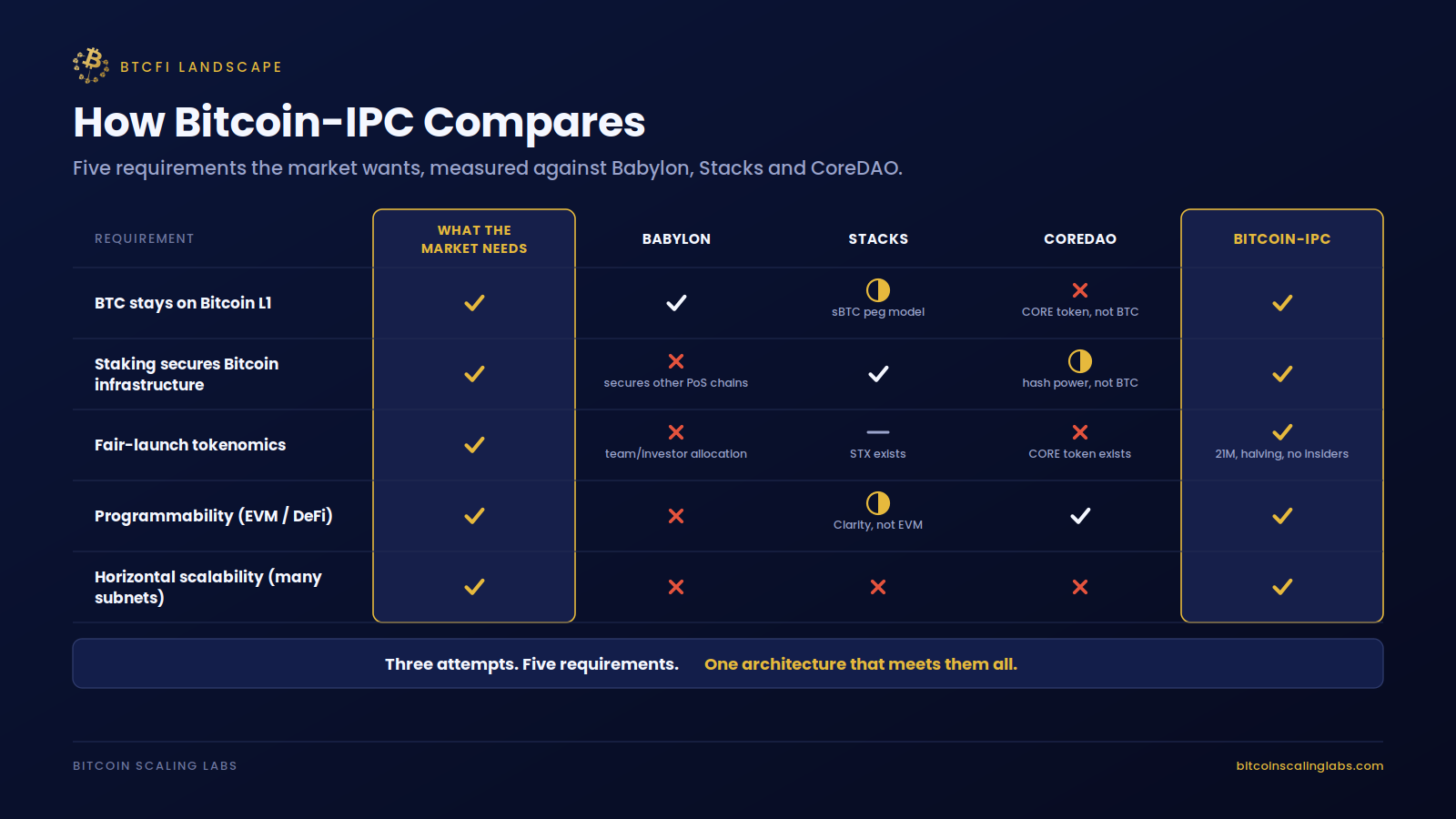
No single project gives a BTC holder the full picture: stake your BTC on Bitcoin, secure Bitcoin-anchored infrastructure, earn a fair-launched reward, and build programmable products on top.
That's the gap Bitcoin-IPC is designed to fill.
What Bitcoin-IPC Takes From Each Lesson
Bitcoin-IPC didn't arrive at its design in isolation. It's built on the three lessons above.
From Babylon: BTC must stay on Bitcoin L1. Bitcoin-IPC validators stake BTC directly on Bitcoin L1 through L1 transactions, securing the underlying infrastructure. No wrapping, no bridging, no custody transfer. The BTC sits in the holder's control until it's staked into a subnet's multisig on Bitcoin itself. Babylon proved this is what the market demands. Bitcoin-IPC keeps it.
From Stacks: Anchoring must be clean, with no hidden trust assumptions. Bitcoin-IPC subnets checkpoint their state to Bitcoin L1. Every cross-subnet transfer is routed through Bitcoin. There's no peg model, no separate signer set, no federation between the subnet and Bitcoin. The relationship is direct: the subnet produces blocks, checkpoints land on Bitcoin, and Bitcoin is the final arbiter. Stacks showed that anchoring matters but seams in the trust model undermine it. Bitcoin-IPC removes the seams.
From CoreDAO: locking BTC is not enough if the economy still runs on an alt. Core time-locks native BTC and lets miners vote with hash, then pays CORE, meters gas in CORE, and dual-stakes CORE against BTC to make the APY look serious. Bitcoin-IPC keeps the staker instinct and drops the CORE loop: BTC is the stake and the unit, and it secures Bitcoin-anchored subnets that checkpoint to L1, not a separate token L1 that only references Bitcoin.
What Bitcoin-IPC adds that none of them had
Fair-launch tokenomics. IPC-BTC, the reward token for staking BTC into Bitcoin-IPC subnets, is capped at 21 million token supply with a BTC-like halving schedule. No tokens are reserved for the team or investors. Emission is protocol-fixed; the market prices the token. What hashpower is to BTC, staked BTC is to IPC-BTC. That is the Bitcoin-shaped incentive layer BABY, STX, and CORE did not ship.
Full EVM programmability. Bitcoin-IPC subnets run the EVM natively. Lending, tokenised assets, stablecoins, Solidity, MetaMask, on chains whose stake is L1 BTC and whose state checkpoints to Bitcoin. Core shipped EVM on a CORE economy. Stacks shipped Bitcoin anchoring without EVM. Bitcoin-IPC ships both.
Horizontal scalability. Any group of Bitcoiners can permissionlessly open a subnet. Throughput is not one global mempool. More subnets, more capacity, same L1 for checkpoints. Bitcoiners do not need to flock to a shared security context of a single Bitcoin L2. The protocol networks all subnets together, through Bitcoin L1, in a single horizontally scalable ecosystem. Stacks and Core cannot do that as single chains. Babylon was never that product.
The Market Proved the Demand. The Architecture Caught Up.
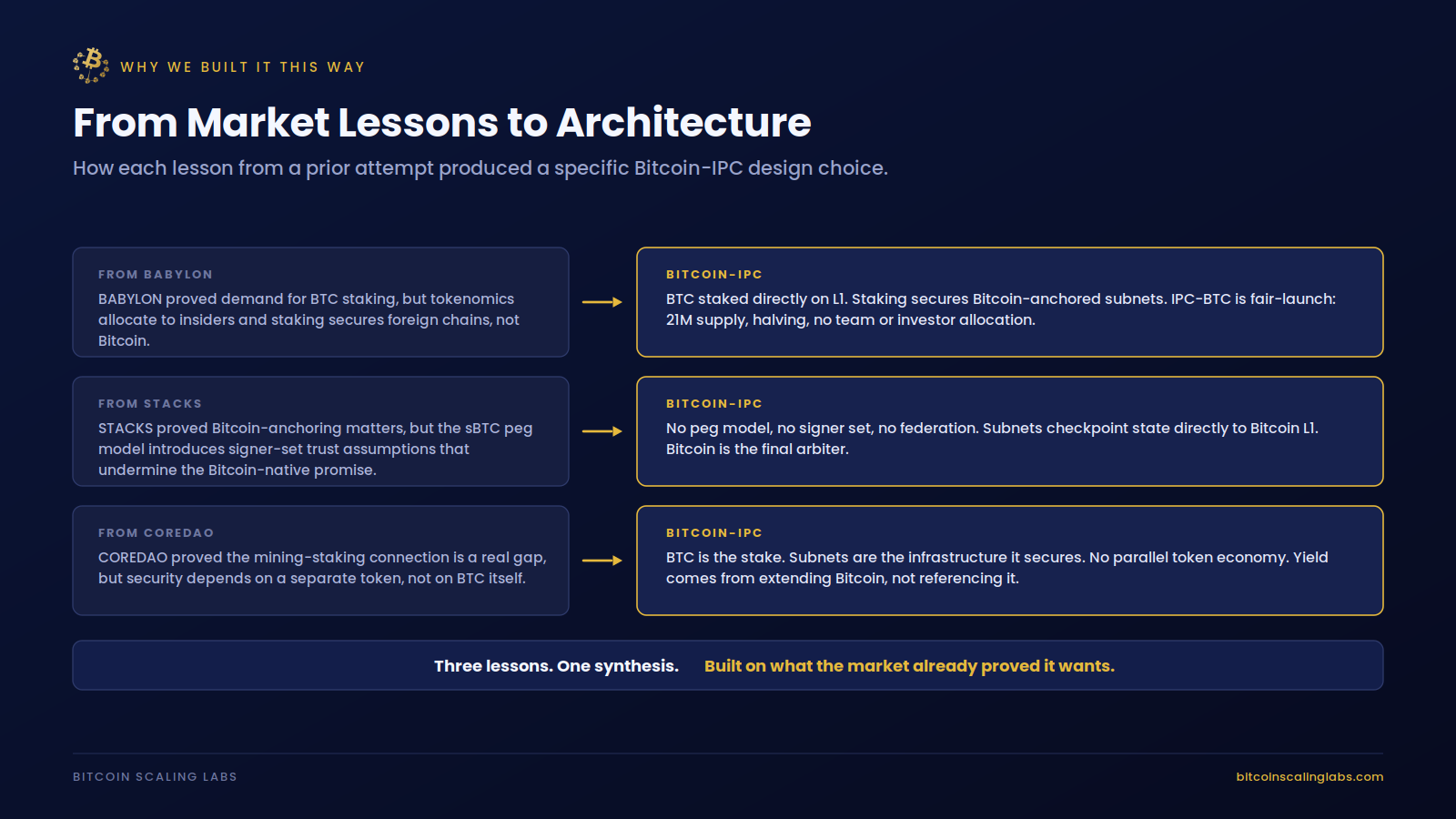
Three serious attempts. Three real contributions. And a set of lessons that, taken together, describe exactly the system the market has been asking for.
BTC stays on Bitcoin. Staking secures Bitcoin infrastructure. Tokenomics are fair and Bitcoin-native. Programmability is real and EVM-compatible. The network scales horizontally.
Bitcoin-IPC is what you get when you build from those lessons instead of arguing with them.
Building Bitcoin-native staking or yield infrastructure, or exploring what it could look like for your treasury or institution? Contact us to find out more and explore collaborations.
To understand how institutional BTC yield without leaving Bitcoin works in practice, read The Custodian's Yield Dilemma.