Institutions holding Bitcoin want it to do more than sit still. They want yield. And the custodians who safeguard that Bitcoin are now caught between two promises they can't currently keep at the same time: give clients access to onchain opportunity, and never compromise the custody that made those clients trust them in the first place.
You don't have to take our word that this tension is real. The largest custodians are showing it to us in public, in the products they ship.
The dilemma, named by the market leader
In June 2026, one of the world's biggest qualified custodians, Bitgo, rolled out two different ways for institutional clients to earn onchain yield within the space of three weeks. The revealing part wasn't the launch. It was the tradeoff baked into the design.
"We believe institutions are looking for ways to access onchain opportunities but also expect the security and oversight that come with institutional custody," the CEO said, describing the strategy.
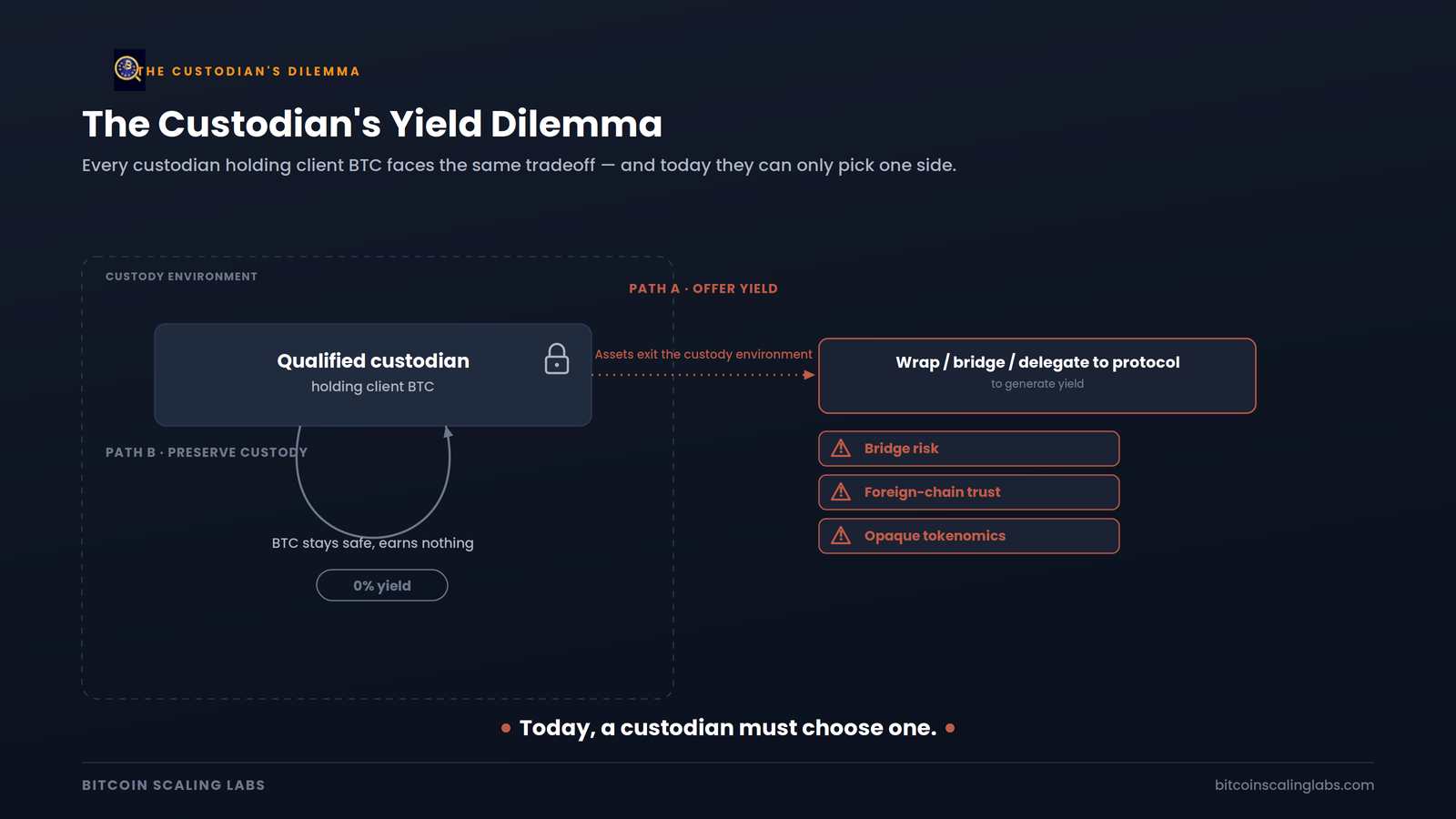
Access to yield, plus the security and oversight of institutional custody. That is the whole game. But look at how the products actually resolved it. One structure kept client assets inside the qualified custody environment. The other, a route into a lending protocol, required those assets to leave the custody environment to earn. Once deployed, they forgo the protection of qualified custody.
That is the custodian's yield dilemma, stated not as theory but as a product decision made by the most sophisticated custodian in the market. To offer the yield, the assets had to step outside the very protection the client is paying for.
If the leading custodian is making that tradeoff visibly, every custodian is making it quietly.
Why the tradeoff exists
The dilemma isn't caused by yield. It's caused by how the yield is currently reached.
Almost every route to yield on Bitcoin runs through one of two doors:
Wrap it. Convert BTC into a token on another chain, usually an Ethereum-based representation, so it can enter that chain's DeFi. The moment you do, the client no longer holds Bitcoin. They hold a claim on Bitcoin, dependent on a bridge and a foreign chain's security. For a fiduciary, that's not a convenience tradeoff. It's a change in what the client actually owns.
Delegate it. Hand the BTC to a staking or lending protocol. Now the client's assets sit inside someone else's smart contracts and tokenomics, often with insider allocations and counterparty exposure a custody risk committee can't sign off on.
Both doors lead to the same place: the Bitcoin leaves the security model that made it worth custodying, and it leaves the custody environment the client is paying for. This is why bridge and peg risk has climbed to the top of the industry's concern list. In BTC yield today, the bridge is the dominant risk, and it's the one a custodian is least able to defend to a client.
We made the same argument for tokenized assets in our piece on reaching Bitcoin holders without wrapping, and for the vault capital that can't currently reach BTC in the capital pool no multi-chain vault can touch. The pattern repeats everywhere: the workaround is always to take Bitcoin somewhere it wasn't designed to go.
The resolution: yield without the asset leaving
The dilemma dissolves the moment yield stops requiring the Bitcoin to leave.
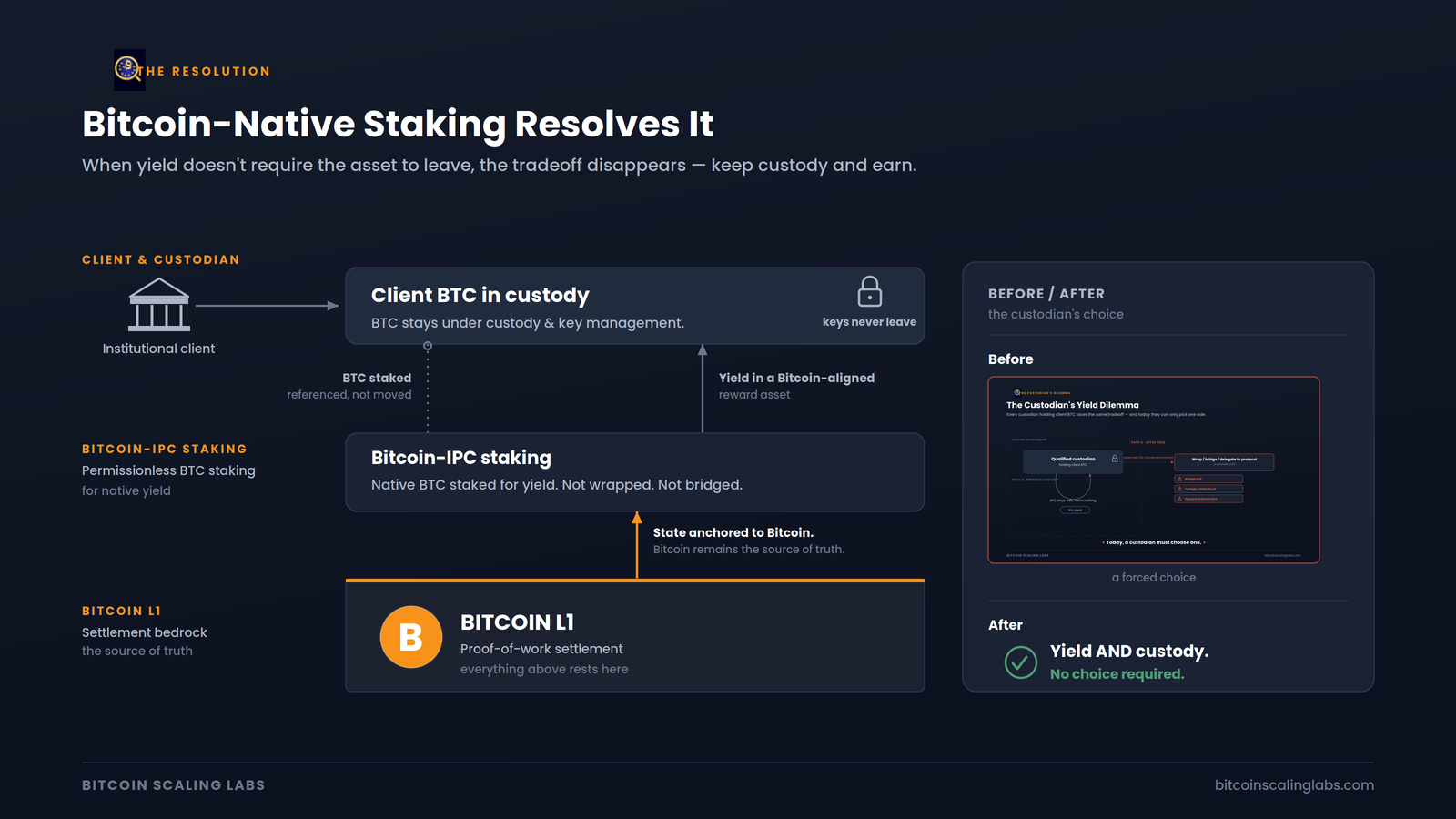
Bitcoin Scaling Labs is building Bitcoin-IPC, a network of interoperable Bitcoin L2 subnets secured by Bitcoin itself. Validators stake native BTC. Subnet state is periodically checkpointed to Bitcoin L1, so Bitcoin remains the settlement and security anchor. The BTC is never wrapped into a foreign-chain token, and never bridged away from Bitcoin's security.
For a custodian, that changes the shape of the problem entirely:
- The client earns yield on their Bitcoin without the asset exiting the custody environment.
- There is no bridge to a foreign chain, so there is no bridge risk to explain to a risk committee.
- The asset stays native Bitcoin, anchored to Bitcoin L1 as the source of truth.
- Yield is denominated in a Bitcoin-aligned reward asset built on Bitcoin's own economic model: fixed supply, halving emissions, fair launch, no insider allocation.
And because the subnets run a standard EVM environment, the same rail carries programmability, tokenized assets, stablecoins, and RWAs issued and transacted with standard tooling, with Bitcoin underneath as ground truth. The custodian isn't just solving yield. They're gaining a Bitcoin-native platform to build institutional products on.
The custodian keeps control too. A custodian can operate its own subnet, or share one with selected peers, under governance it defines, rather than pushing client assets into a single shared L2 and inheriting that chain's entire risk surface.
The yield dilemma isn't a law of nature
It exists because, until now, earning on Bitcoin meant taking Bitcoin somewhere less safe. Remove that requirement, and the choice a custodian is currently forced to make, yield or custody, stops being a choice at all.
The custodians shaping that future are the ones deciding, now, to build it rather than wait for it.
Bitcoin Scaling Labs is bringing on initial design partners for the launch of Bitcoin-IPC. If you're a qualified custodian, treasury, or institution exploring Bitcoin-native yield and programmability, contact us to find out more and explore collaborations.
Learn more about Bitcoin-IPC:
Related reading: Reaching Bitcoin holders without wrapping · The capital pool no multi-chain vault can reach · The two demand curves that make Bitcoin scaling urgent