
SWIFT has connected the world's banks for more than 50 years, and it did it without making a single bank give up its independence. There's no shared global ledger that every bank writes to. No central database holding everyone's balances. SWIFT standardized one thing: the messages that let sovereign institutions route value to each other.
That's a deeper lesson for cross-chain design than most of the blockchain industry has absorbed. The way to connect many independent systems isn't to merge them. It's to agree on how they talk.
What SWIFT actually is
SWIFT is often misunderstood as a payment network that moves money. It doesn't move money. It moves messages.
When a bank in Tokyo needs to send value to a bank in Frankfurt, SWIFT doesn't debit one shared account and credit another. Each bank keeps its own books. SWIFT carries a standardized message between them, and the banks settle through their own accounts and correspondent relationships. The genius is in the addressing and the message format. Every institution has a standardized identifier, and every message follows a structure both sides understand.
This let thousands of sovereign banks, in different countries, under different regulators, with different internal systems, interoperate without surrendering control of their own ledgers. Sovereignty preserved, interoperability achieved. That combination is exactly the problem cross-chain design keeps failing to solve.
Where blockchain interoperability went wrong
The dominant approach to connecting chains has been to insert a bridge: a committee that holds assets on one chain and issues a representation on another. It's the equivalent of forcing two banks to hand their reserves to a third party that vouches for both sides.
That model concentrates risk in the bridge, which is why bridges have been the single largest source of exploits in crypto, around $2B and counting. SWIFT never worked this way. No bank deposits its reserves with SWIFT. SWIFT carries the message; the institutions retain their assets.
The blockchain industry built the custodian SWIFT deliberately avoided, and then spent years trying to make that custodian safer. The architectural lesson was available the whole time.
The pattern Bitcoin-IPC borrows
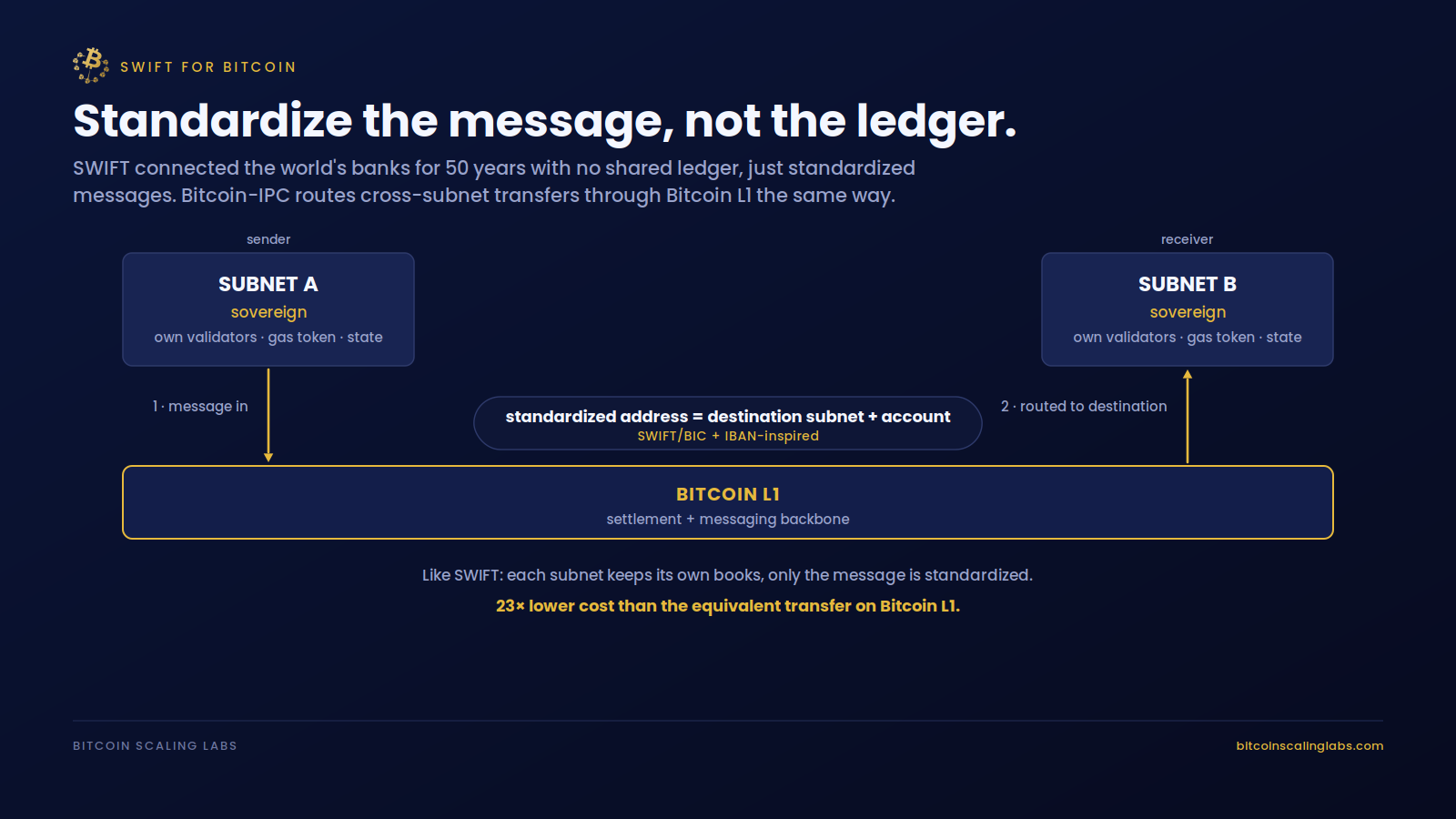
Bitcoin-IPC applies the SWIFT pattern to Bitcoin L2 subnets. Each subnet is sovereign, with its own validator set, gas token, and state. Like banks, they keep their own books. What they share is a standardized way to route value to each other.
The addressing is inspired by SWIFT and IBAN. A cross-subnet transfer carries a standardized address that identifies the destination subnet and account, the same way a SWIFT/BIC code and IBAN identify a destination bank and account. The transfer routes through Bitcoin L1, which acts as the settlement and messaging backbone that every subnet already trusts.
This matters for the people your team talks to. An institution that has operated on SWIFT for decades understands sovereign institutions routing value through a shared messaging standard intuitively. It's the model they already run on. Bitcoin-IPC presents the same mental model with Bitcoin as the settlement layer.
Why it's 23x cheaper than native L1
The cost advantage isn't a marketing number. It comes from the architecture.
Settling every transaction directly on Bitcoin L1 is expensive and slow, because L1 processes around twelve transactions per second and every transaction competes for the same block space. Bitcoin-IPC subnets process transactions internally at high throughput, and use Bitcoin L1 for what it's best at: final settlement and cross-subnet messaging.
Because the heavy transaction volume happens on the subnets and only the routing and settlement touch L1, the effective cost of a cross-subnet transfer is up to 23x lower than performing the equivalent transfer natively on Bitcoin L1. The aggregate effect lifts achievable monetary throughput on Bitcoin from 12 tps toward 273 tps across subnets, narrowing the gap with traditional rails like SWIFT's ~500 tps, all without changing Bitcoin L1.
The analogy isn't fluff. It's a design decision.
It would be easy to read "SWIFT for Bitcoin" as a marketing line. It isn't. It's a description of a deliberate architectural choice with 50 years of operational history behind it.
SWIFT proved that the way to connect sovereign systems at global scale is a shared messaging and addressing standard, not a shared ledger and not a custodian. That proof has held through five decades, thousands of institutions, and trillions in value. Bitcoin-IPC takes that proven pattern and applies it to a network of Bitcoin L2 subnets, with Bitcoin L1 playing the settlement role. The fragmentation across 300-plus isolated Bitcoin L2s exists precisely because the industry kept building bridges instead of a messaging standard.
A 50-year-old banking protocol already solved the hardest part of interoperability. The work is applying it to Bitcoin.
Want to understand how cross-subnet routing works for your institution? Contact us to find out more and explore collaborations.